
What is Piano Preparation, and Why Does It Matter?
A piano may be new, beautifully made, and safely delivered to a showroom, but that doesn’t necessarily mean it’s ready to sound and respond at its best.
That’s where piano preparation comes in. It’s the process of evaluating an instrument and completing the work it needs before it reaches its new owner. Depending on the piano, that may include inspection, tuning, regulation, voicing, cleaning, cosmetic care, and other adjustments.
Each part of the process serves a different purpose. Tuning brings the strings to the correct pitch. Regulation helps the keys and action respond evenly and consistently. Voicing refines the piano’s tone and helps create greater balance across the keyboard.
Together, these steps help the piano offer the tone, touch, and performance it was designed to provide. That means the piano you try in the showroom gives you a more accurate sense of what you can expect once it’s in your home.
If you’re still early in the buying process, our Guide to Buying an Acoustic Piano covers the broader questions of size, quality, cost, new vs. used options, tone, touch, and in-person comparison.
What does piano preparation include?
Piano preparation begins with an evaluation of the individual instrument. A technician looks at how the piano arrived, evaluates its current musical and mechanical condition, and determines what work is needed before it’s ready for the showroom or its new home.
The process may include:
Inspection
The piano is checked for shipping damage, cabinet concerns, loose or misaligned parts, pedal operation, tuning stability, and the overall condition of the keyboard and action. For a used piano, the inspection may also identify wear, earlier repairs, or components that need more extensive attention.
Tuning
Tuning adjusts the tension of the piano’s strings so the notes are at the correct pitch and relate properly to one another. Because changes in climate, string tension, and transportation can affect tuning stability, a piano may need tuning more than once as it settles into a new environment.
Regulation
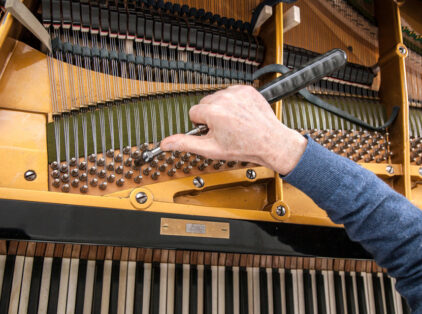
Piano regulation, sometimes called action regulation, is the process of adjusting the instrument’s mechanical systems so the keys, action, dampers, and pedals work evenly and respond consistently.
Felt, cloth, leather, and wooden components can settle or change over time, which may affect how the piano feels beneath the player’s hands.
Voicing
Piano voicing is the process of adjusting the instrument’s tone, primarily through careful work on the hammers.
The goal isn’t to make every piano sound the same. It’s to create greater consistency across the keyboard while preserving the instrument’s individual tonal character.
Cleaning and cosmetic care
Preparation may also include cleaning the interior and exterior, polishing the cabinet, touching up minor blemishes, and making sure the piano looks as well cared for as it sounds.
Not every piano needs the same work or the same amount of time. Preparation should respond to the condition, design, age, and intended use of the individual instrument so the piano can offer the kind of playing experience it was built to provide.
What should you notice when you play?
A well-prepared piano should feel even and responsive from one end of the keyboard to the other. The keys and pedals should work consistently, the tone should sound balanced across different registers, and the piano should stay reasonably stable in tune.
That doesn’t mean every piano should sound or feel the same. Preparation helps reveal the character of the individual instrument so you can decide whether it suits the way you play.
If you’re curious about where those tonal differences come from, see Why Do Pianos Sound Different?
Preparation is only one part of evaluating an instrument. Our guide to What Makes a Good Acoustic Piano explains how tone, touch, construction, consistency, and musical fit work together.
Why do new pianos need preparation?
A new piano has already been carefully built, adjusted, and inspected at the factory. But between the factory and the showroom, it may travel thousands of miles by ship, rail, or truck and pass through changing temperatures and humidity levels along the way.
During that time, the piano’s strings, felt, wood, and moving parts can begin to settle. Its tuning may shift, and small changes in the action can affect how evenly the keys respond. None of this necessarily means there’s a problem with the instrument. It’s a normal part of transporting and acclimating a piano to a new environment.
Once the piano reaches the showroom, it may need time to adjust before a technician evaluates what it needs. That work may include:
- Inspecting the cabinet, pedals, keyboard, action, strings, and other components
- Bringing the piano to the correct pitch
- Adjusting the action for a more even, consistent touch
- Refining the tone across the keyboard
- Cleaning and preparing the cabinet for display
After you select a piano, the technician may check it again and complete any final tuning, regulation, voicing, or other adjustments needed before delivery.
Keep in mind that a piano may need additional tuning after it adjusts to the temperature and humidity in its new home. Your dealer or technician can recommend an appropriate service schedule.
How is a used piano prepared differently?
Preparing a used piano usually begins with more investigation. Unlike a new instrument, a pre-owned piano may have a long history of use, maintenance, repairs, moves, and exposure to changing conditions.
The first step is to understand the piano’s current condition. A technician may look for signs of wear, evaluate tuning stability, inspect the action and structural components, review any available service history, and identify repairs or replacement parts that may be needed.
A used piano may then receive many of the same core services as a new one, including tuning, regulation, voicing, cleaning, and cabinet care. The difference is that the work must account for the instrument’s age, previous use, and existing wear.
Cosmetic preparation may also be more involved. Minor scratches, worn edges, fading, and other signs of use can often be cleaned, polished, or touched up without completely refinishing the piano.
The amount of work varies considerably. Some used pianos need only routine service and adjustment. Others may require repairs or replacement of worn components before they’re ready for a new owner. When the instrument is a good candidate for the work, careful service can help restore much of the tone, responsiveness, and enjoyment that made the piano appealing in the first place.
It’s also important to distinguish preparation from more extensive work. A piano that has been reconditioned, refurbished, restored, or rebuilt has typically received repairs or component replacement beyond ordinary tuning, regulation, voicing, and cosmetic care.
If you’re considering a used piano, it’s important to know exactly what work has been done. Terms such as “prepared,” “reconditioned,” and “rebuilt” don’t describe the same level of service.
New vs. used piano preparation at a glance
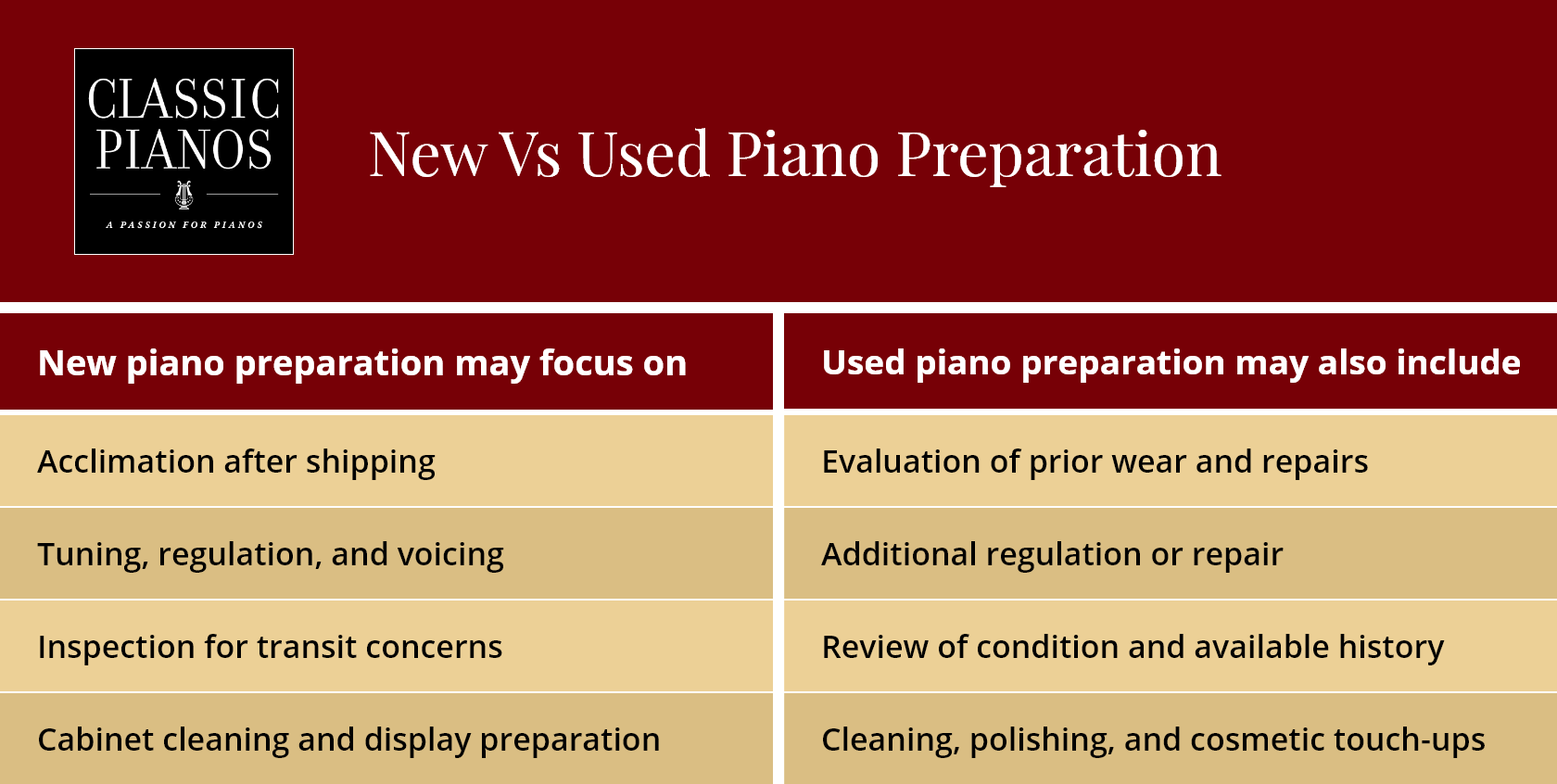
| New piano preparation may focus on | Used piano preparation may also include |
|---|---|
| Acclimation after shipping | Evaluation of prior wear and repairs |
| Tuning regulation and voicing | Additional regulation or repair |
| Inspection for transit concerns | Review of condition and available history |
| Cabinet cleaning and display preparation | Cleaning polishing and cosmetic touch ups |
If you’re still deciding between the two, see our full comparison of New vs. Used Acoustic Pianos.
Do all pianos need the same amount of preparation?
No. The basic goals may be similar, but the amount and type of work depend on the individual piano.
A new upright may need relatively modest tuning and adjustment after shipping and acclimation. A high-performance grand may call for more detailed regulation and voicing because it’s designed to respond to finer differences in touch and tone. A used piano may need additional cleaning, repairs, or correction for wear before the usual preparation can begin.
The work required can depend on:
- Age and condition
- Construction and performance level
- Previous use and service history
- Environment and climate exposure
- Intended use
The goal isn’t to give every piano the same checklist. It’s to give each instrument the attention it needs to offer the best possible playing experience.
Piano preparation vs. repair, reconditioning, and rebuilding
Piano preparation focuses on getting an instrument ready to be played, shown, or delivered. It may include inspection, tuning, regulation, voicing, cleaning, cosmetic care, and minor adjustments.
That work is different from correcting significant wear, damage, or deterioration.
Repair
A repair addresses a specific problem, such as a broken string, sticking key, damaged pedal, loose component, or worn action part. Some repairs may be completed as part of preparing a used piano, but they go beyond routine adjustment.
Reconditioning
Reconditioning is a broader process used to return a piano to good playing condition. It may include cleaning, repairs, regulation, and replacement of selected parts where needed.
The Piano Technicians Guild defines reconditioning as cleaning, repairing, and adjusting a piano, with parts replaced where specifically needed. A rebuild involves much more extensive disassembly and replacement of worn or deteriorated components.
Rebuilding
Rebuilding is much more extensive. It generally involves disassembling the piano, inspecting its major systems, repairing or replacing worn or deteriorated components, and then reassembling and adjusting the instrument.
Depending on the piano, rebuilding may involve work on the strings, pinblock, soundboard, bridges, action, dampers, or cabinet. It’s usually reserved for instruments whose quality, design, history, or potential makes that level of investment worthwhile.
Restoration
“Restoration” is sometimes used interchangeably with rebuilding, but the term may also describe work intended to preserve or return an instrument to a particular historical or manufacturer-specific standard.
Because these terms aren’t always used consistently, ask exactly what work was completed, which parts were repaired or replaced, and who performed it.
The distinction matters because a piano described as prepared, repaired, reconditioned, restored, or rebuilt may have received very different levels of work. The label alone doesn’t tell the full story.
For a more detailed comparison of these processes, see Piano Restoration vs. Rebuilding vs. Refurbishing: What’s the Difference?
What should you ask about piano preparation before delivery?
Before your piano is delivered, ask what preparation has been completed and what service you should expect after it arrives. Policies vary by dealer and instrument, so it’s better to understand the details than to make assumptions.
The dealer should be able to explain the work in specific terms rather than simply saying that the piano has been “checked” or “serviced.”
Useful questions include:
- What inspection and preparation has this piano received?
- Will it be tuned before delivery?
- If it’s a used piano, were any repairs or parts replacements needed?
- Is an in-home tuning included after the piano has had time to settle?
- Where should the piano be placed in my home?
- What should I do if something doesn’t sound or feel right after delivery?
- How are service and warranty concerns handled?
Placement also matters. Your dealer or technician can help you choose a stable location away from direct heat, drafts, and strong sunlight, all of which can affect the piano over time.
Keep in mind that a piano may need additional tuning after it adjusts to the temperature and humidity in its new home. Your dealer or technician can recommend a service schedule based on the piano and its new environment.
Experience a professionally prepared piano in Reno
The difference preparation makes is easiest to understand when you can experience it for yourself.
At Classic Pianos Reno, you can compare more than 300 new, used, and restored pianos. Our technicians prepare instruments for showroom display and delivery, and our team can explain what work has been completed on the pianos you’re considering.
Visit our Reno showroom at 111 W. Plumb Lane, or call 775-902-2088. You’re welcome to explore at your own pace, ask questions, and compare how different instruments sound and feel.
Frequently asked questions
How long does piano preparation take?
It depends on the instrument and the work it needs. A new piano may need time to acclimate after shipping, while a used piano may require additional cleaning, adjustment, or repairs.
Is piano preparation included in the price?
Dealer policies vary, so ask what preparation is included in the purchase price and whether any services are billed separately. You should also understand what support is included before and after delivery.
Will my piano need tuning after delivery?
In most cases, yes. Moving the piano itself may not cause a major change, but the temperature and humidity in its new home can affect tuning stability as the instrument acclimates.
Your dealer or technician can recommend when to schedule the first in-home tuning. New pianos may need more frequent tuning during their first year as the strings and other components continue to settle.
When it’s time for follow-up service, learn more about piano tuning in Reno or speak with one of our technicians.
Does piano preparation affect the warranty?
Proper preparation and routine maintenance generally support the piano’s performance and condition, but warranty terms vary by manufacturer and dealer.
Ask who is authorized to perform service, what the warranty covers, and whether any maintenance requirements must be followed. Classic Pianos Reno offers warranty coverage on both new and used pianos. Ask our team for the specific terms that apply to the instrument you’re considering.
How is piano preparation different from regular maintenance?
Preparation happens before a piano is displayed or delivered and focuses on getting the instrument ready for use. Regular maintenance continues after purchase and may include ongoing tuning, regulation, voicing, cleaning, and repairs as the piano ages and responds to use and seasonal changes.
Preparation gives the piano a strong starting point. Maintenance helps preserve its tone, touch, and performance over time.